|
| |
| |
 |
The Fishermen's Journal |
|
|
FLUOROCARBON LEADER COMPARISON
by
Mark Smith
Caveats on Comparisons and Claims
When we first began carrying fluorocarbon leader there were
few suppliers, and all shared some similar characteristics. We only supported
100% fluorocarbon leader, never a coated product. All proved to be invisible in
water. When folks would ask for a recommendation I'd simply say, "just make sure
it's 100% FL, beyond that they're all pretty much equal." All manufacturer's
products were stiff, and all absorbed a bit of water. Most importantly, all
proved very effective when it came time to go fishing. When the bite was picky,
fluorocarbon leader could make a difference - a big difference. I've seen days
when you couldn't buy a bite unless you were using the stuff, and I've also seen
days when it made absolutely no difference since the fish were eating everything
that touched the water...including cigarette butts!
As time
passed, more manufacturers entered the field. As a result we've seen some
competition between manufacturers each trying to gain some marketing advantage.
Sometimes marketing claims are made that exceed proven results, sometimes the
hype is only hot air blown by an over-reaching sales/marketing department. As a
fishing tackle retailer I share some common concerns with our clients. We can't
stock everything, and the stuff we stock had better work or I've blown dollars
that should be used elsewhere. So, we do some testing here as a regular course
of business. We have invested in test equipment and try to look beyond the hype
to sort out facts.
So, let's get
down to business. I am still of the opinion that all fluorocarbon leader are
pretty much equal, so long as they are 100% fluorocarbon. We are hearing some
claims from certain manufacturers about strength, softness, diameter and
stretch... various properties beyond pure fishing effectiveness. It was our
intent to do some simple testing to see if there really are any differences
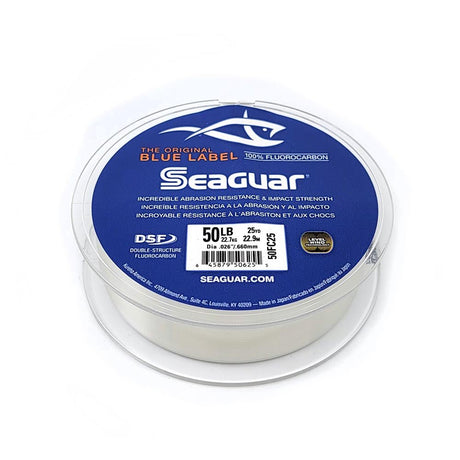
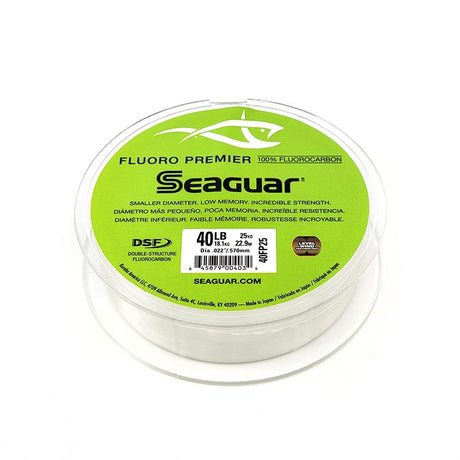
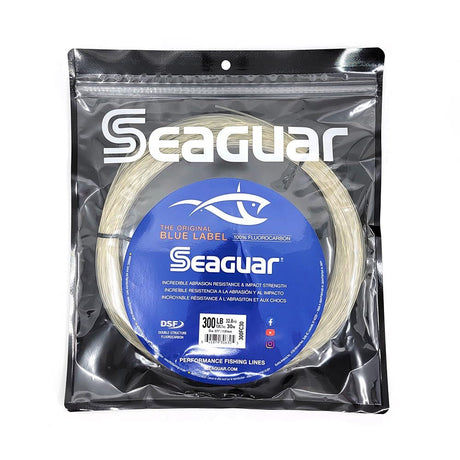
between products. We chose to evaluate Seaguar, Stren, Blackwater and YoZuri. We
omitted some manufacturers, may revisit this exercise at a later date to add
their statistics to the mix.
TEST
EQUIPMENT
We used a
$2.6K line tester made by Scale Master. The Black Max is IGFA certified, used in
many tournaments, and VERY RELIABLE. We also used a couple different micrometers
to arrive at line diameter measurements.
PROBLEMS
WITH STUDY
Our sample was
not huge, only 10 tries per line test/per manufacturer. We only used one spool
of line (pulled from our shelf) for testing purposes. The lines were not wet,
they were dry and this could result in different findings in the field. While we
tried to treat all measures consistently, this does not mean that we mimicked
the way a fish would run and pull on the line. We were consistent with the
pressure, not jerky, so real world conditions were not met.
METHOD
First, I used
a 3' section of leader and checked the line diameter in three different
locations on the line and arrived at an average measurement. Usually there were
very small variances, insignificant. Then, I cut a 4' section and put it
in the Black Max tester. The "jaws" were closed allowing only a 1" gap of line.
Then the jaws were moved apart at a steady rate until the line snapped. At that
point we'd check the breaking test and also measure how much stretch one inch of
line would allow prior to breaking. This was repeated 10 times for each line.
Those numbers provided a mean measurement which is what we'll examine for
comparison.
Comparisons
were made with 20# and 40# lines.
We used
Izorline mono as a reference monofilament line, for both diameter and breaking
strength. It's a fairly remarkable line in terms of strength, perhaps not
typical, but it gives us a reference point in terms of stretch and diameter to
compare with fluorocarbon.
DATA /
RESULTS
|
Manufacturer |
Diameter |
Avg. Break |
Avg. Stretch |
|
Izorline 20# |
0.016 |
41.5 |
3.25 |
|
Seaguar 20# |
0.016 |
30.667 |
3.167 |
|
Blackwater 20# |
0.017 |
31.333 |
2.9 |
|
YoZuri 20# |
0.013 |
28 |
2.767 |
|
Stren 20# |
0.016 |
28 |
3.5 |
|
Izorline 40# |
0.022 |
54.5 |
4.1 |
|
Seaguar 40# |
0.025 |
41.25 |
3.45 |
|
Blackwater 40# |
0.0245 |
45.75 |
3.25 |
|
YoZuri 40# |
0.0235 |
44.5 |
3.25 |
|
Stren 40# |
0.024 |
41.5 |
3.35 |


OBSERVATIONS & OPINIONS
Line diameter is an important consideration when comparing performance. We've
seen many claims by mono manufacturers about how strong their line is, without
reference to diameter. [For what it's worth, Izor based their line on diameter,
using Ande as a reference. Ande's 20# line measured a certain size, Izor's line
of the same diameter was marketed as a 20# line, when in reality it would test
far higher based upon newer copolymer manufacturing.] In our testing, we did
find that fluorocarbon leader does indeed stretch less than mono, however we
were surprised to see that in general it does stretch more than we initially
thought possible.
|
0.748897 |
correlation
diameter and break |
|
|
|
|
0.478603 |
correlation
diameter and stretch |
|
|
|
|
0.694674 |
correlation
break and stretch |
We found a positive correlation between line diameter and break strength,
and a positive relationship between break strength and stretch. However there
was not a great association between line diameter and stretch.
In our testing, we did find that fluorocarbon leader does indeed stretch less
than mono, however we were surprised to see that in general it does stretch more
than we initially thought possible. Products from ALL manufacturers allowed some
degree of stretch. Products from ALL manufacturers strength tested well, at or
beyond their claimed rating.
What's the point? Well, if you were trying to run a short topshot of
fluorocarbon leader into your spectra backing, having some stretch would be a
good thing. Perhaps you might chose your fluorocarbon based upon stated stretch
measurements. From the limited research we did, under the conditions we used,
I'd be hard pressed to recommend one FL line over another from the standpoint of
stretch alone. I'd look at other properties, many of which are beyond the scope
of this writing. For instance, limpness, ability to maintain strength after
being in water for 30 minutes... These are better real world considerations I
feel. From the standpoint of breaking strength and stretch, I can make no claims
regarding one manufacturer or another based upon the results from this
comparison. That's something you might do for yourself...


|